


-2.jpg?width=240&height=83&name=Menu-Banner%20(5)-2.jpg)
.jpg?width=240&height=83&name=Menu-Banner%20(8).jpg)





It's a common misstep in digital transformation: equating cloud migration with actual modernization. Many organizations move legacy systems into the cloud, expecting immediate gains in scalability, performance, and cost-efficiency, only to find they've simply relocated their challenges. Lift-and-shift may get you to the cloud faster, but it doesn't get you further.
It doesn't untangle outdated logic. It doesn't reduce long-term technical debt. It doesn't prepare your data estate for analytics, automation, or AI.
If anything, it postpones transformation while inflating cloud spend.
True modernization requires more than movement. It calls for re-engineering, a thoughtful redesign of your data architecture, pipelines, and governance model to leverage the advantages of modern platforms fully.
In this blog, we explore why re-engineering outperforms lift-and-shift in both strategic value and operational resilience, and what leaders should prioritize to build scalable, future-ready data ecosystems.
The lure of Lift-and-Shift
Lift-and-Shift, as the name suggests, is a strategy where an organization takes its on-premises applications and data systems and moves them to a cloud environment with minimal changes. The primary appeal of this approach is its speed and apparent simplicity. It allows a business to check the box on "cloud migration" without a massive upfront investment in redesigning their architecture. The thinking is that you can get the immediate benefits of the cloud, like elastic compute and storage, without the complexities of a large-scale project. For many, it's a quick win that gets them to the cloud faster, but this initial speed often comes at the expense of long-term strategic value.
The problem with lift-and-shift
Moving data from one environment to another without transforming its structure, logic, or usability creates a brittle foundation. It's the equivalent of copying a physical filing cabinet into a digital folder system. This way, nothing is truly changed.
Here's what's typically left behind in a Lift-and-Shift approach:
- Technical debt: Legacy code, outdated schema, and monolithic ETL logic remain intact.
- Poor cloud alignment: Architectures aren't optimized for performance, scale, or cost (FinOps).
- Governance gaps: Metadata, lineage, and documentation are missing or disconnected.
- Minimal automation: Heavy manual effort is still required post-migration.
Most importantly, a Lift-and-Shift approach stifles innovation. Without a modern, flexible data foundation, it becomes difficult to implement advanced analytics, machine learning, and other transformative technologies that are native to the cloud.
Teams often spend months or even years rebuilding pipelines, redefining data quality standards, and re-architecting workflows to adapt to changing business needs. This phase two work should have been part of phase one.
Re-engineering: The strategic and sustainable path
Re-engineering is a fundamentally different approach. It's not just about moving systems; it's about redesigning them from the ground up for the cloud. This means embracing cloud-native architecture, where systems are built using services like serverless functions, managed databases, and scalable object storage. It involves redesigning data pipelines to be more efficient and resilient and adopting a microservices-based approach to break down monolithic applications into smaller, more manageable components.
While re-engineering requires a greater upfront investment in time and resources, it is a strategic decision that pays dividends for years to come. It's an investment in building a future-proof, scalable, and genuinely modern data platform, demonstrating the importance of long-term planning in data modernization strategies.
Key steps in the process:
- Volumetric and complexity analysis: Identifying what can be automated, what must be customized.
- Schema redesign: Aligning structure with modern data lakehouse or medallion architectures.
- ETL and DB code conversion: Automatically translating logic into scalable, cloud-optimized pipelines.
- Data validation and governance baked in: Ensuring traceability, documentation, and quality from the start.
Where reverse and forward engineering fit in
Both forward engineering and reverse engineering matter as they serve complementary purposes in software and system development. The dual-engineering approach ensures that modernization is not just technically sound but also business-aligned, transparent, and scalable.
- Forward engineering is the traditional process of designing and building new systems or software from initial requirements and specifications. It follows a top-down approach, starting with high-level design and moving down to implementation. This approach is essential to creating new products, innovations, and technologies.
- Reverse engineering works in the opposite direction: starting with an existing system, it analyzes and extracts design and architectural information. This helps understand legacy systems, recover lost documentation, improve or modernize existing solutions, or enable interoperability.
The importance of both:
- Forward engineering drives creation and innovation, enabling new functionalities and meeting new user needs.
- Reverse engineering provides insights into existing systems, allowing debugging, maintenance, re-documentation, and informed re-engineering or migration efforts.
Together, they enable a full lifecycle approach, where you can create new systems and also understand, maintain, and improve existing ones effectively, which is critical in software evolution and data modernization contexts.
The tangible advantages of re-engineering
The benefits of a re-engineering strategy are both profound and far-reaching:
- Cost efficiency: By using cloud-native services and optimizing your architecture, you can achieve significant long-term savings. Serverless functions and elastic scaling ensure you only pay for the resources you use, eliminating the need to over-provision.
- Enhanced performance: A cloud-native design leads to drastic improvements in the speed, reliability, and throughput of your data processing capabilities. Data pipelines become more efficient, and applications are more responsive.
- Scalability & flexibility: Re-engineering creates a foundation that can effortlessly grow and adapt to your business needs. Whether you're handling a sudden spike in traffic or expanding into new markets, your data infrastructure can scale on demand.
- Future-proofing: A modern, cloud-native architecture is the prerequisite for adopting advanced technologies. It sets the stage for you to easily integrate machine learning models, real-time analytics, and AI-powered applications.
- Reduced risk: By leveraging the security features and best practices of your cloud provider, you can improve your security posture and simplify compliance maintenance.
A framework for a successful re-engineering project
So, how do you get started? A successful re-engineering project follows a structured, phased approach:
Phase 1
Assessment and discovery: Begin by thoroughly auditing your current systems. Identify your business goals and define what success looks like. This phase is about understanding what you have and what you need. It involves assessing the current state of your data systems, understanding your business objectives, and defining the key performance indicators (KPIs) that will measure the success of your re-engineering project.
Phase 2
Architectural design: Blueprint your new cloud-native data architecture. This is where you select the right services and design the data pipelines that will power your future business.
Phase 3
Incremental migration: Instead of a single, risky 'big bang' migration, adopt a phased approach. Migrate components one by one, using a pattern like the Strangler Fig. This pattern, inspired by the way a strangler fig tree grows around a host tree, allows you to gradually replace parts of your existing system with new, cloud-native components. This minimizes disruption to your business operations and reduces the risk of a failed migration.
Phase 4
Optimization and validation: Post-migration, the work isn't over. Continuously monitor your new environment, optimize performance, and validate that your new systems are meeting the defined business goals.
Re-engineering vs. lift-and-shift
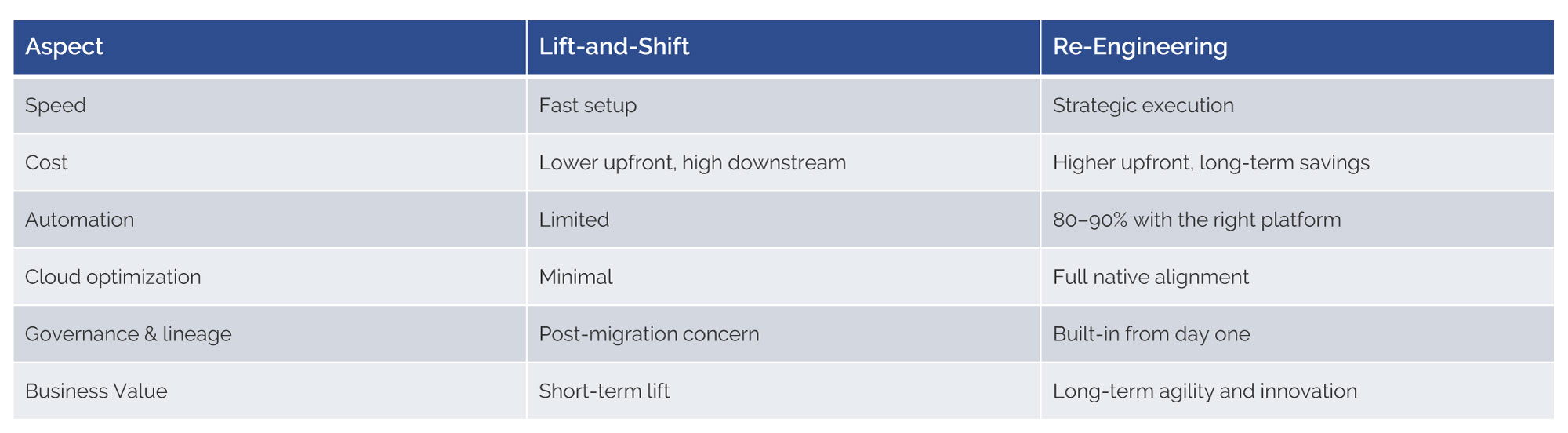
The re-engineering mindset: What leaders should prioritize
Data modernization has transformed from a tactical checkbox to a strategic enabler of AI, analytics, and operational agility. To excel in this area, CXOs must ask different questions:
- Are we just lifting and shifting, or are we engineering for what's next?
- Is our platform migration automated, validated, and documented
- Can we not only move quickly but also adapt quickly?
Re-engineering doesn't just save time. It sets the foundation for data products with embedded SLAs, for FinOps visibility, for governance-by-design, and for AI-readiness from day one.
Conclusion
At Mastech, we help enterprises modernize with intelligence, not just movement. Through our partnership with DataSwitch, we bring a platform-first, automation-driven, and business-aligned approach to data transformation. Because in the race to modernize, the winners won't just be those who move fast. They'll be the ones who build right.
Are you ready to rethink your data modernization strategy? Connect with Mastech's modernization experts to schedule a modernization assessment. Let's help you stop carrying forward technical debt and start engineering the data foundation your business really needs.