


-2.jpg?width=240&height=83&name=Menu-Banner%20(5)-2.jpg)
.jpg?width=240&height=83&name=Menu-Banner%20(8).jpg)




Retail is a complex, interconnected web of processes, systems, and stakeholders. Whether shopping online or in-store, customers demand seamless experiences and up-to-date product information at every touchpoint. To meet these expectations, retailers rely on Product Information Management (PIM) systems to act as a single source of truth for product data—ensuring speed, accuracy, and consistency across channels. Now, with Artificial Intelligence (AI) enhancing PIM capabilities, retailers can automate data validation, personalize offerings, and achieve greater efficiency than ever before.
Why PIM Matters in Retail
In today’s fast-paced retail environment, speed, accuracy, and consistency are non-negotiable. The need to launch new products, manage complex vendor relationships, and expand store networks means retailers must have clean, reliable, and accessible data at all times. That’s where Product Information Management (PIM) systems come in—acting as the single source of truth for product, vendor, and location information, PIM ensures that every touchpoint across the retail journey is supported by up-to-date and consistent data. By leveraging Product Information Management (PIM) systems enhanced with Artificial Intelligence (AI), retailers have reported up to a 30% reduction in product data errors, a 50% decrease in manual data entry time, and 99% consistency in product information across channels. These improvements have contributed to a 20% increase in customer satisfaction scores and a 15% rise in conversion rates for omnichannel retailers, underscoring how the combination of PIM and AI drives more agile operations, seamless customer experiences, and superior data quality throughout the retail ecosystem.
PIM Integration Across the Retail Ecosystem
The image below visually represents the interconnected nature of modern retail: 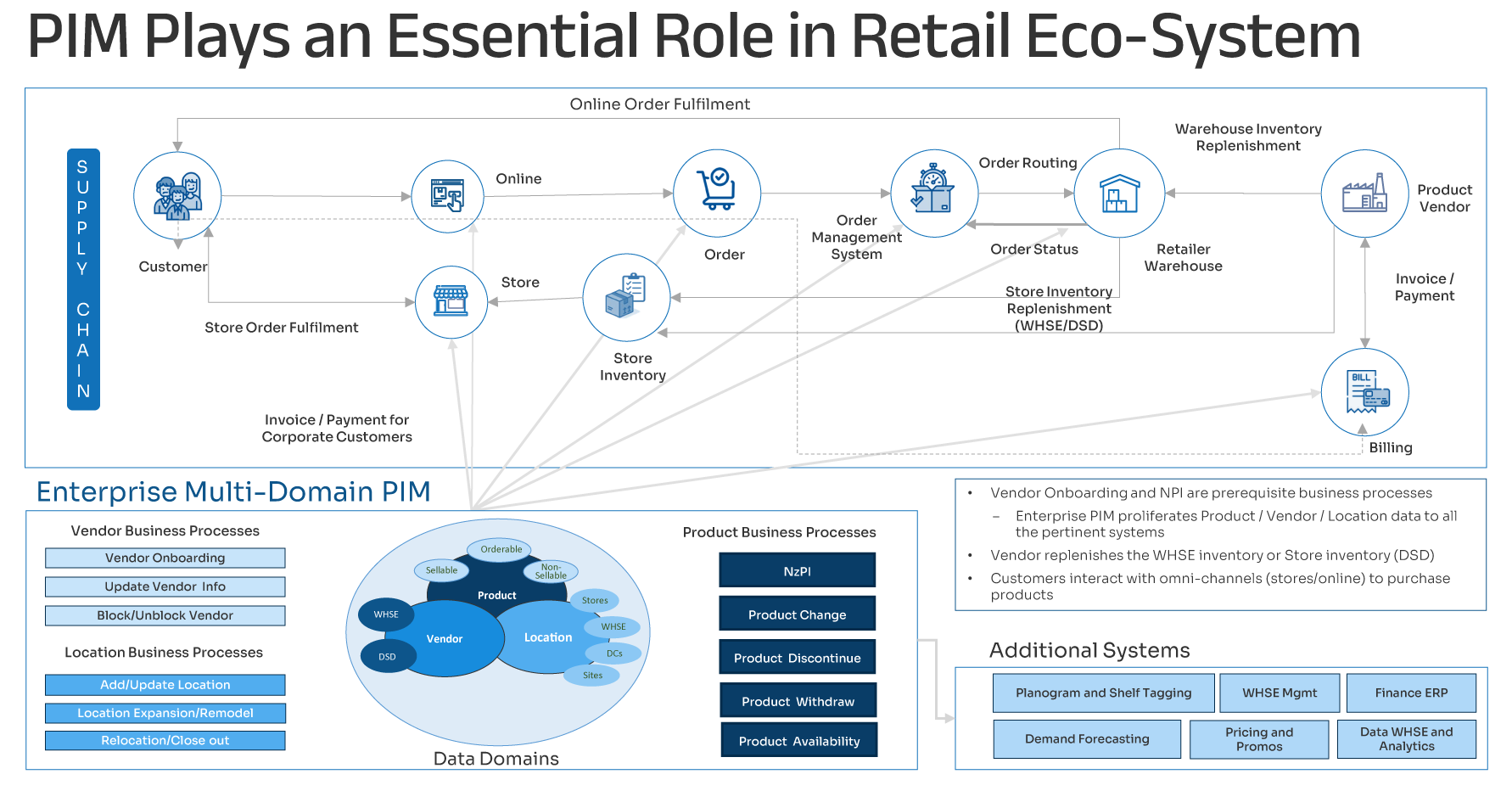
Customer Journey
Product Information Management (PIM) supports the entire customer journey, whether shoppers are placing orders online or making purchases in-store. PIM ensures that every touchpoint, from browsing products to order fulfillment, provides consistent and accurate product data. This reliability helps retailers deliver seamless experiences that meet customer expectations for speed and transparency.
Supply Chain Integration
PIM serves as a bridge across the retail supply chain, connecting vendors, warehouse operations, and billing systems. By centralizing product and vendor information, PIM streamlines communication and data exchange throughout the supply chain. This integration helps retailers maintain accurate inventory levels, coordinate with suppliers, and ensure that billing processes are efficient and error-free.
Order Management System (OMS)
The Order Management System (OMS) functions as a central hub for order routing and inventory updates. PIM feeds the OMS with up-to-date product data, enabling the system to accurately track inventory status and route orders efficiently. This integration is crucial for minimizing stockouts, fulfilling orders promptly, and keeping customers informed throughout the purchasing process.
AI-Driven Automation
Artificial Intelligence (AI) further optimizes these processes within the retail ecosystem. Through intelligent forecasting, AI predicts demand patterns, which enables better inventory planning and helps reduce delays. Additionally, AI enhances order routing by analyzing real-time data, ensuring that orders are fulfilled in the most efficient manner possible. This automation contributes to a more responsive and resilient retail operation.
Enterprise Multi-Domain PIM in the Retail Ecosystem
- Product Domain Management: PIM oversees the full product lifecycle—introduction, updates, discontinuation, and availability—ensuring downstream systems have accurate data for inventory and order fulfillment.
- Vendor Domain Management: PIM streamlines vendor onboarding, updates, and compliance, maintaining current records and enabling smooth supplier integration for reliable supply chain operations.
- Location Domain Management: PIM tracks store openings, remodels, and closures, keeping all systems updated on retail locations for seamless operational adjustments.
- AI Integration Across Domains: AI automates product categorization, data enrichment, and vendor compliance checks, improving speed, accuracy, and reducing manual effort.
- Centralized and Standardized Data: PIM unifies data across domains, ensuring all supporting systems operate with accurate, up-to-date information for efficient decision-making and ecosystem cohesion.
Key Benefits of PIM in Retail
- Data Accuracy: PIM systems eliminate data inconsistencies and duplications across retail channels. AI-powered anomaly detection and correction further ensure product information is reliable for customers and internal systems.
- Operational Efficiency: PIM streamlines vendor onboarding and product launches. AI-driven automation reduces manual work, speeding updates and compliance for smoother workflows and faster time-to-market.
- Customer Experience: Consistent product details across all channels build customer trust and satisfaction. AI in PIM delivers personalized product recommendations, boosting engagement.
- Scalability: PIM enables retailers to expand into new markets and channels. AI-assisted demand forecasting and inventory optimization help businesses grow while maintaining control over product data and inventory.
PIM Integration with Supporting Systems
Product Information Management (PIM) systems add value through integration with other retail systems. By connecting to planogram, shelf tagging, and Warehouse Management Systems, PIM streamlines merchandising and inventory control. Integration with Finance ERP ensures accurate billing and regulatory compliance. Linking with forecasting, pricing, promotions, and analytics supports strategic decision-making. Artificial Intelligence further enhances these connections, enabling predictive demand forecasting, dynamic pricing, and real-time insights for better business performance.
The Bottom Line
As retail continues to evolve, PIM will remain a cornerstone for businesses striving to deliver accurate, timely, and engaging product experiences across every touchpoint. With AI woven into the fabric of PIM, retailers can move beyond static data management to intelligent, adaptive systems that drive personalization, efficiency, and growth. Investing in a robust PIM solution integrated with AI is no longer optional - it’s a strategic imperative for success in today’s omnichannel world.