.svg)



-2.jpg?width=240&height=83&name=Menu-Banner%20(5)-2.jpg)
.jpg?width=240&height=83&name=Menu-Banner%20(8).jpg)




Enterprises are investing heavily in data modernization, AI initiatives, governance programs, and automation. But none of it creates value unless it reaches the customer. A Data-and-AI enterprise is only real when the customer experience reflects it. CX is where transformation becomes visible, felt, and judged.
Yet CX programs continue to fail in the same predictable way. In most organizations, six months of customer feedback collection produces zero operational change. CX teams surface insights. Business teams acknowledge them. Nothing in the journey actually shifts.
This gap is structural:
- data exists
- insight exists
- automation exists
- but no decisioning system connects them
CX becomes a reporting function, not an operational engine.
CX must instead be treated as the outcome layer of the enterprise, the layer where data, AI, and decisions converge into real interventions.
The Problem: Data-Rich, Experience-Poor
Most enterprises operate with a fragmented customer view. Data is scattered across surveys, chat transcripts, emails, web events, call center logs, loyalty platforms, and social feedback. Each channel experiences the customer in isolation.
A common example looks like this:
1. A long-term customer attempts to upgrade a product online.
2. The checkout process fails.
3. The customer enters chat support. The agent has no visibility into the customer’s prior attempts, frustration, or intent.
4. Meanwhile, automated marketing messages continue pushing irrelevant offers unrelated to the customer’s actual need.
5. Hours later, the support team sends a delayed follow-up.
6.The customer receives a survey, reports dissatisfaction, and never hears back.
This is not a system outage. It is an interpretation failure.
In one large retail enterprise I worked with, customer sentiment data was already being captured across surveys, contact center transcripts, and digital channels. However, each dataset lived in a different system with no shared interpretation layer. While frustration signals were spiking in near real time, outbound campaigns continued uninterrupted and support teams remained blind to the customer’s prior failed attempts. The organization did not lack data or automation; it lacked a decision mechanism to connect customer intent to operational action.
The data was available.
The enterprise could not use it.
The same root issue appears inside CX operations. In one analyzed organization, survey feedback, social posts, chat logs, and call transcripts were stored in separate tools. Only the survey system had a taxonomy. Analysts spent their days logging into multiple systems and manually stitching insights together, producing monthly decks instead of interventions.
Enterprises have automated channels.
They do not have automated understand
The CX Outcome Stack
CX must be re-architected on top of four layers, aligned directly with the pillars used in modern Data-and-AI transformation programs.
.png?width=1000&height=514&name=undefined%20(1).png)
This is the architecture required for CX to act as the enterprise’s outcome layer.
Step 1: Detect What Is Actually Happening
Most journeys are designed on assumptions, not real behavior.
Detection requires a live understanding of:
- cart abandonment
- channel switching
- dwell times on support pages
- repeated failure patterns
- sentiment shifts
- hang-ups
- email fatigue and non-engagement
- topics customers raise repeatedly
Without detection, enterprises see the symptom (abandonment, deflection, churn) but not the cause.
Automating customer journeys without detection creates blind spots that frustrate customers and quietly push them away.
Detection is the ground truth of CX.
Step 2: Decide What Happens Next
Every customer moment requires a decision. Today most enterprises make these decisions through meetings, approvals, and committees. This introduces latency that kills outcomes.
A decision engine replaces coordination with computation.
It answers:
“What should happen next for this customer, right now?”
Without this layer, brands default to generic treatments:
- identical emails to every customer
- irrelevant product pushes
- outreach that ignores current sentiment
- offers disconnected from the customer’s immediate context
Generic action is misaligned action.
It erodes trust.
Decisioning creates precision.
Step 3: Deliver the Action in Real Time
Delivery is where CX either works or fails.
A decision is meaningless unless executed instantly with:
- correct channel
- correct timing
- correct message
- correct sensitivity
- correct suppression logic
Customers now receive roughly 1,200 messages a day from various sources. The majority become noise.
Channel intelligence, the ability to understand which channels to avoid, which to emphasize, and when to escalate, has become a requirement for survival.
Real-time orchestration turns decisions into experiences.
Step 4: Remove the Human Bottleneck
In most CX programs, human throughput is the constraint.
Analysts interpret data manually.
Managers consolidate insights into decks.
Executives review.
Changes happen quarterly, if at all.
This is why many organizations could not name a single operational change driven by their CX program over six months.
AI agents eliminate these bottlenecks by:
- classifying incoming feedback
- tagging themes across channels
- detecting churn signals
- summarizing multi-touch interaction histories
- routing issues to the correct teams instantly
- triggering automated customer interventions
- updating customer profiles with behavioral context
I have repeatedly seen CX teams surface the right insight within days, only to wait months for change because action required cross-team alignment rather than automated execution.
Agents operationalize insight.
A Model for Real-Time CX Intervention
Below is a functional model that integrates detection, decisioning, agents, and orchestration.
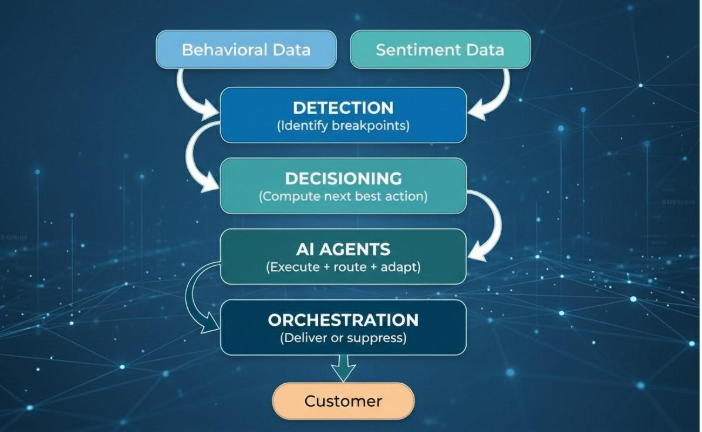
This model replaces reactive CX with adaptive CX.
CX as the Outcome Layer
CX must now serve as the diagnostic surface of the enterprise.
It reveals whether:
- data is unified
- AI is operational
- decisions are automated
- journeys are adaptive
- outcomes are improving
If the customer cannot feel the transformation, the transformation is not real.
The only viable CX strategy in 2026 is to treat customer experience as the outcome layer of your Data-and-AI enterprise.
Closing
CX is no longer a separate discipline. It is the expression of the company’s intelligence, its ability to sense, understand, decide, and act.
When detection is real, decisioning is automated, agents execute instantly, and orchestration aligns to customer context, the experience changes immediately.
This is the path from dashboards to decisions, from feedback to action, from fragmented channels to coherent journeys.
This is CX operationalized.
In the next post, I’ll examine why most CX programs fail to drive operational change, and what has to shift in operating models, not tools, to close that gap.
